The published percentage is only part of the story. Here’s what Viator and GetYourGuide actually cost a tour operator once the full picture is accounted for, and what that number should tell you about your website.
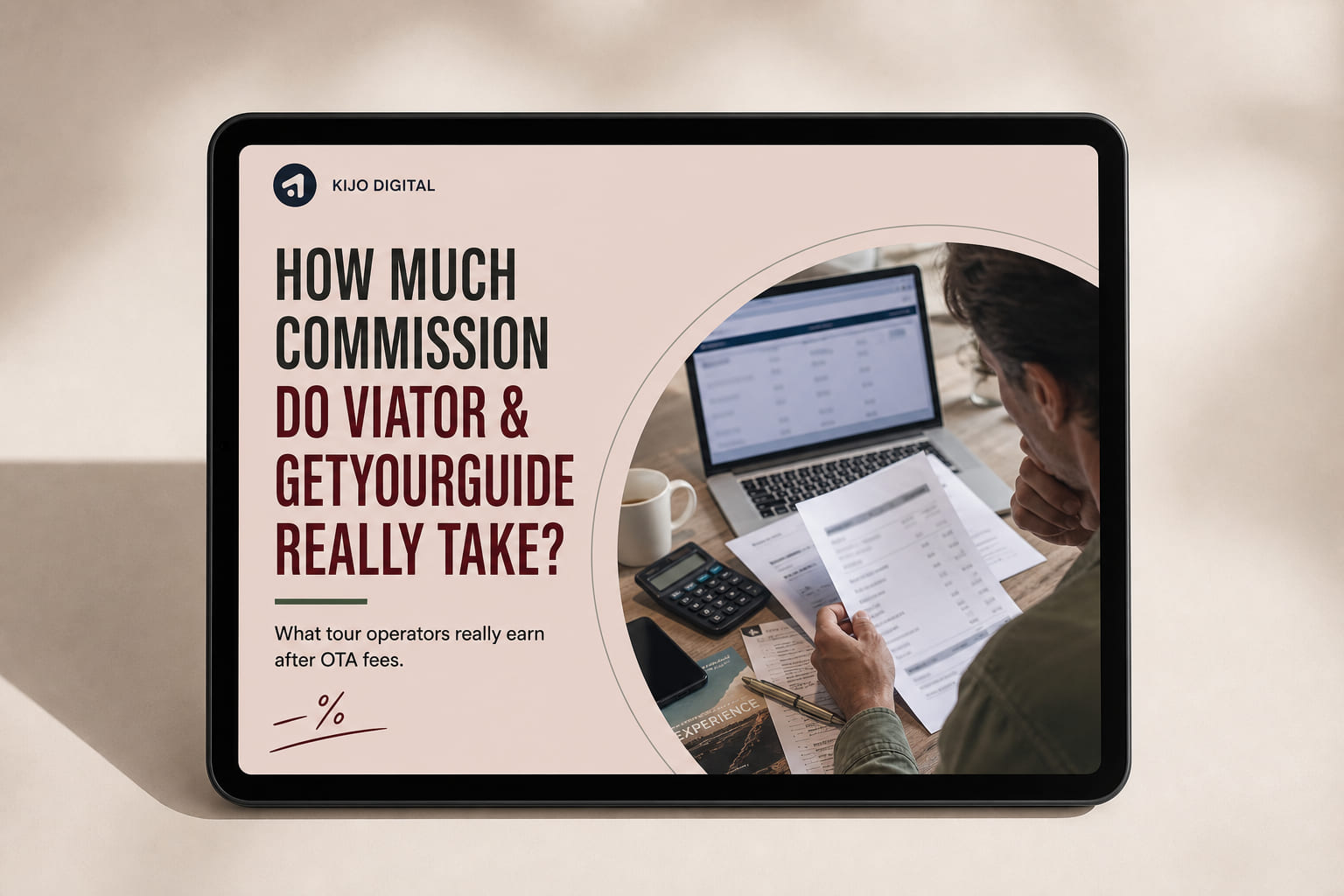
Ask five tour operators what Viator or GetYourGuide takes in commission and you’ll likely get five different answers. That’s not because anyone is wrong, it’s because the headline rate and the rate an operator actually pays are often two different numbers.
Both platforms publish a base commission, and both platforms have optional programmes, placement fees and listing structures that sit on top of it. An operator who only uses the free, standard listing pays close to the base rate. An operator who opts into paid visibility programmes, or who books more volume through a category with a higher take, ends up paying considerably more, without necessarily realising it, because the fee is deducted before the payout rather than itemised separately.
The base commission is the rate on your contract. The effective commission is what you actually keep once placement programmes, per-product fees and payment processing are factored in. Most operators only ever look at the first number.
Viator’s published base commission for most operators sits around 20 percent. That’s the floor, not the ceiling. Viator also runs an optional paid placement programme (sometimes referred to as Accelerate) that boosts visibility in exchange for a higher commission on bookings it influences, and some operators are subject to a per-product listing arrangement introduced more recently. Once these are factored in, many operators report an effective take closer to 25 to 30 percent on the bookings the platform drives.
Because Viator is part of the same group as TripAdvisor, a listing on Viator also tends to surface on TripAdvisor’s own booking module, which is useful for reach but means the same commission structure effectively applies across both surfaces for many operators.
GetYourGuide’s commission typically falls in a similar band, generally between 20 and 30 percent. The exact figure for any given operator depends on the destination, the activity category, and the volume of bookings already flowing through the platform. Operators with a longer track record and higher volume on GetYourGuide sometimes negotiate a lower rate; newer operators or smaller categories tend to sit at the higher end.
As with Viator, the rate on the contract is the starting point for the conversation, not the final answer. It’s worth checking your own account dashboard or your account manager directly for the rate that actually applies to your listings, since blog posts and forum threads (this one included) can only describe the general range.
“The commission percentage is the starting point of the cost, not the end of it. It's what happens after that number that determines whether an OTA is a good channel or an expensive habit.”
Viator and GetYourGuide dominate the conversation because they’re the two largest marketplaces for tours and activities in most markets, but they’re not the only ones. TripAdvisor Experiences largely mirrors Viator’s structure, as noted above. Klook, popular in Asian markets and increasingly used by international travellers, generally operates in a comparable commission range. Smaller or regional marketplaces vary more widely, and it’s worth checking the actual signed agreement for each rather than assuming the industry range applies exactly.
What’s consistent across all of them is the underlying trade-off: reach and discovery in exchange for a meaningful share of the sale price, and in most cases, the loss of the traveller’s contact details.
We'll review your current site and OTA mix and show you where a properly built website would recover the most commission, free, no obligation.
The commission line is the visible cost. Three other costs sit underneath it and rarely get discussed:
None of this means OTAs are a bad channel. For discovery, especially for a newer operator with limited reviews of their own, they’re genuinely useful. It does mean the commission percentage alone understates what dependency on them actually costs.
| Platform | Published base commission | Typical effective range | What affects the rate |
|---|---|---|---|
| Viator | Around 20% | 20% to 30% | Paid placement programmes, per-product listing fees |
| GetYourGuide | 20% to 30% | 20% to 30% | Destination, category, booking volume |
| TripAdvisor Experiences | Around 20% | 20% to 30% | Largely mirrors Viator, same parent company |
| Klook | Varies by market | 15% to 30% | Region, category, negotiated terms |
Ranges are general industry figures for context. Your own contracted rate may differ, always confirm the exact terms in your account dashboard or agreement.
Take a tour priced at R2,000 per person. At a 25 percent effective commission, an OTA booking nets the operator R1,500. A direct booking through your own website, minus a typical 2 to 3 percent payment processing fee, nets closer to R1,940 to R1,960. That’s a difference of roughly R450 per booking, before accounting for the fact that a direct customer is also one you can market to again.
An operator selling 1,000 experiences a year at R2,000 each, currently entirely through OTAs at a 25% effective commission, recovers roughly R450,000 a year in margin by shifting just half of that volume to direct bookings. Even a tenth of that shift is a meaningful number, often enough to fund a proper website rebuild several times over.
Knowing the commission is only useful if it changes what you do next. Two things tend to move the needle fastest: making your own website at least as easy to book on as your OTA listing, and giving travellers who found you through an OTA a reason to book with you directly next time. Our direct booking website checklist covers exactly what that website needs, and a tour operator website built with this in mind is usually the single highest-leverage way to change the ratio between OTA and direct bookings over a season.
The goal isn’t to leave Viator or GetYourGuide overnight. It’s to stop them being the only place a traveller can book you, and to keep more of what each booking is actually worth.
Viator's published base commission is around 20 percent. Many operators end up paying more than this once optional placement programmes and per-product listing arrangements are factored in, so the effective rate for a lot of operators sits closer to 25 to 30 percent.
GetYourGuide's commission typically falls between 20 and 30 percent, and the exact figure depends on your location, activity category and booking volume with the platform.
Yes. Both Viator and GetYourGuide set rates that can differ by destination, category and how much volume an operator books through the platform, so two operators selling similar tours can end up on different effective rates.
For most operators, yes, at least for now. OTAs bring discovery and reviews that are hard to replace overnight. The goal isn't to leave them, it's to stop them being your only booking channel.
Build a website that makes booking directly at least as easy as booking on the OTA, then give past guests and new visitors a reason to use it: visible pricing, a fast booking flow, and a way to stay in touch after the trip so the next booking comes direct.
I design and build conversion-focused websites for travel, hospitality and trade businesses, and I've set up bookings on all of these systems, WooCommerce most of all. This comparison reflects what actually works on real operator sites, not vendor marketing.
Book a free 30-minute strategy call. We'll look at your OTA mix and your current site, and show you what shifting even a small share of bookings direct would be worth.
Book a free strategy call →