
People are visiting your site but the phone stays quiet. Here are the 10 most common reasons appliance repair websites leak customers, and the practical fix for each, with WhatsApp, mobile and local trust in mind.
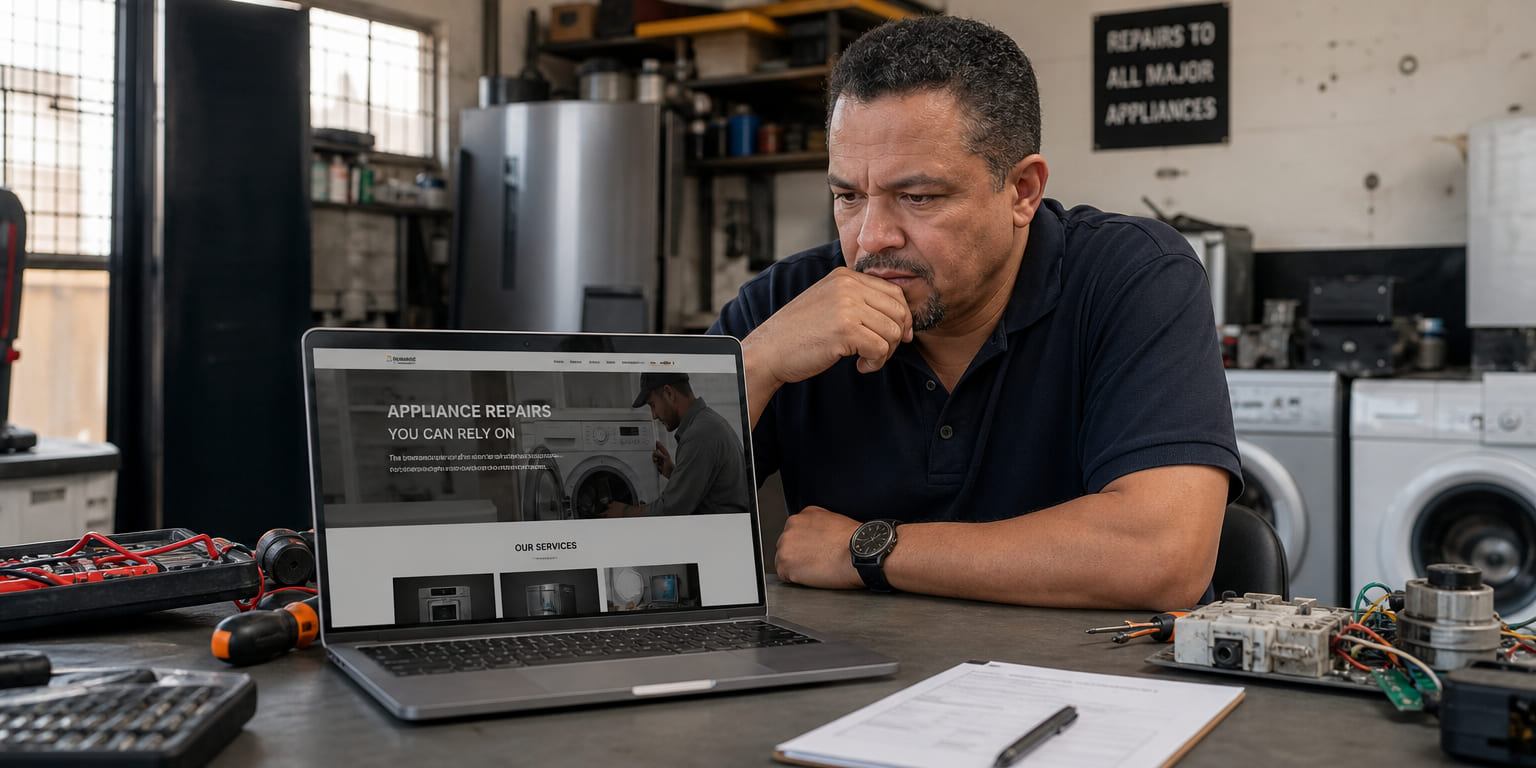
If your appliance repair website gets visitors but the phone stays quiet, it is tempting to blame the traffic and buy more clicks. Usually that is the wrong diagnosis. A broken fridge or washing machine is an urgent, high-intent problem, so the people landing on your site already want the exact thing you sell. They are not tyre-kickers. The demand is arriving. It is leaking out before the call.
Think about what that visitor is actually doing. They are standing in the kitchen, water on the floor or food going warm, searching on their phone, and they will call the first business that looks close, capable and easy to reach. If your site makes them work to find out whether you cover their area, whether you fix their brand, or where the phone number even is, they tap back and call the next result. The gap between a busy phone and a quiet one is rarely traffic. It is the ten things below.
The map pack shows only three businesses, and on a phone they fill the screen. Most people searching for an urgent repair pick one of those three and call. If you are not in the pack for your area, you are competing for the much smaller share of attention that scrolls further down.
The fixes fall into three groups, in the order the customer’s mind works: whether you are the right fit for them, whether they trust you, and whether reaching you is effortless. Work through them top to bottom.
Before anyone books with an operator they’ve never used, your site has to close the trust gap fast, especially when the alternative is a platform they already know.
A customer in Table View or Bellville needs to know in seconds that you actually come out to them. If your site only says “we serve Cape Town” or shows nothing at all, people in the outer suburbs assume you are too far and call someone who names their street.
The fixState the suburbs and areas you cover in plain text, high on the page, and back it with dedicated service-area pages so both customers and Google can see exactly where you work.
Someone with a Defy oven or a Samsung fridge wants to see that exact appliance and brand named. A vague “we repair all appliances” makes them wonder, and wondering sends them to the repairer who says “Samsung fridge specialists” on the page.
The fixList the appliances you fix (fridges, washing machines, tumble dryers, dishwashers, ovens, stoves, microwaves) and the major brands (Defy, Samsung, LG, Bosch, Hisense), and give the big ones their own pages.
Nobody expects a fixed price for a repair sight unseen, but total silence on cost creates hesitation. Customers worry about a mystery call-out fee or paying for a diagnosis that goes nowhere, so they hold off calling.
The fixExplain how a quote works in one or two lines: whether there is a call-out fee, how diagnosis is charged, and any “no fix, no fee” policy. Certainty removes a real reason to hesitate.
“Travellers want security more than savings. The trust signals near your booking button do more for conversion than any discount.”
Before anyone books with an operator they’ve never used, your site has to close the trust gap fast, especially when the alternative is a platform they already know.
Star ratings are the strongest trust signal you have, and appliance customers lean on them heavily because they cannot judge your work in advance. If your Google reviews sit on a separate page, or nowhere at all, you are asking people to trust you on faith.
The fixShow real Google ratings and a few recent reviews on the homepage and near every call button, ideally mentioning the appliance or brand fixed so they feel specific and real.
Customers spot stock imagery instantly, and a smiling model in a spotless studio kitchen signals a business hiding behind a template. Your own photos of real technicians, your branded van and finished jobs do the opposite.
The fixReplace stock images with genuine photos of your team, your vehicle and completed repairs. Slightly imperfect but real always beats polished but fake for a trades business.
A workmanship guarantee, a parts warranty and any accreditation are small signals that do heavy lifting at the moment of decision. Their absence quietly reads as risk, especially against a competitor who states “6-month workmanship guarantee” up front.
The fixPlace your guarantee, parts warranty and any credentials next to the call to action, not buried on an About page. Say it plainly and put it where the decision happens.
We'll go through your site as a first-time mobile customer with a broken appliance, and show you exactly where the calls are leaking, free and with no obligation.
Before anyone books with an operator they’ve never used, your site has to close the trust gap fast, especially when the alternative is a platform they already know.
On a phone, a number that is just text, or tucked in the footer, forces the customer to copy, switch apps and paste. Many will not bother. The single most common reason a repair site gets visits but no calls is that calling is not one tap.
The fixMake the number a tappable call button in the header, visible without scrolling, and repeat it through the page and at the end. One tap to dial, every time.
Plenty of South African customers would rather message than call, and WhatsApp lets them send a photo of the appliance, the model plate or the leak. If your only option is a phone call or a contact form, you lose every customer who prefers to type.
The fixAdd a WhatsApp button beside your call button, with a pre-filled message like “Hi, I need a quote for a…”. It lowers the effort to enquire and gives you the detail to respond well.
An urgent search does not wait for a slow page. Heavy images and a bloated theme can leave your site loading for several seconds on mobile data, and impatient customers leave before they ever see your number.
The fixCompress and correctly size every image and clean up the build so the site meets Google's Core Web Vitals. This is core site speed and performance work, and it lifts both calls and rankings.
A quote form asking for ten fields before a customer can say “my dryer stopped heating” loses most people. And most first-time visitors will not call on the first visit, so if nothing captures them, that interest is gone for good.
The fixCut the form to a few fields (name, number, appliance, suburb) and add a light capture, such as a callback request, so interested visitors who are not ready to call can still be followed up. Turning more of these into enquiries is the heart of conversion rate optimisation.
Travellers spot stock imagery instantly, and it quietly signals that the experience might be as generic as the photo. Your own photography is the one visual asset an OTA listing can't replicate.
The fixReplace every stock image with real photos of your actual tours, guides and guests. Imperfect but genuine beats polished but fake.
Secure-payment icons, cancellation terms, industry memberships and local accreditation are small signals that do heavy lifting at the moment of decision. Their absence reads as risk.
The fixAdd a short row of trust signals next to every call to action: secure payment, free cancellation window, and any accreditation you hold.
Run your own site against all ten. Tick each one you can honestly say you have right; your score updates as you go. Anything you cannot tick is very likely costing you calls.
Start with the fixes that need no rebuild. Add a tap-to-call button and a WhatsApp option, put your Google reviews near the call button, and state your suburbs and the brands you fix, all this week. Those alone will move the number of calls you get from the traffic you already have.
The deeper problems, a genuinely fast site, proper service-area and brand pages, a structure that guides an urgent visitor straight to the call, usually mean rethinking how the site is built. That is where a website built for a repair business earns its keep, and why the businesses that get found and get called are rarely the best technicians, but the ones whose website does its job. Getting found in the first place is the next lever, and we cover it in our guide on how appliance repair companies rank in Google’s local map pack.
Traffic without calls almost always means a conversion problem, not a traffic problem. The usual causes are a phone number that is not tappable on mobile, no WhatsApp option, unclear service areas, thin trust signals like missing reviews, and a slow site that stalls during an urgent search. Fixing those turns the visitors you already have into calls and WhatsApp enquiries.
If your site gets visits but few calls, fix the site first. Paying for more clicks to a page that does not convert just means paying to lose more people. Improving how the site turns visitors into calls lifts the return on every visit you already earn or pay for, including your ad spend.
Very. Many South African customers prefer WhatsApp to a phone call, and it lets them send a photo of the appliance, the model plate or the fault. A visible WhatsApp button often captures enquiries that would otherwise be lost, because it is lower effort than calling and gives you the detail you need to respond well.
As fast as possible, because most repair searches happen on a phone during an urgent moment. A page that takes several seconds to load on mobile data loses impatient visitors before they ever see your number. Compressing images and meeting Google's Core Web Vitals is usually the single biggest technical lever on calls.
For most repair businesses, yes. Dedicated pages for the appliances and brands people search, such as fridge repair or Samsung washing machine repair, both rank better in search and convert better, because they answer the exact question the customer typed. A single services page cannot do either job well.
I design and build conversion-focused websites for travel, hospitality and trade businesses, and I've set up bookings on all of these systems, WooCommerce most of all. This comparison reflects what actually works on real operator sites, not vendor marketing.
Book a free 30-minute strategy call. We’ll review your site against all ten fixes and show you what closing the gaps is worth in booked jobs.