You don’t need to write a line of code to understand schema markup, or to know why it’s one of the more overlooked pieces of a tour operator’s SEO. Here’s what it actually is, in plain language.
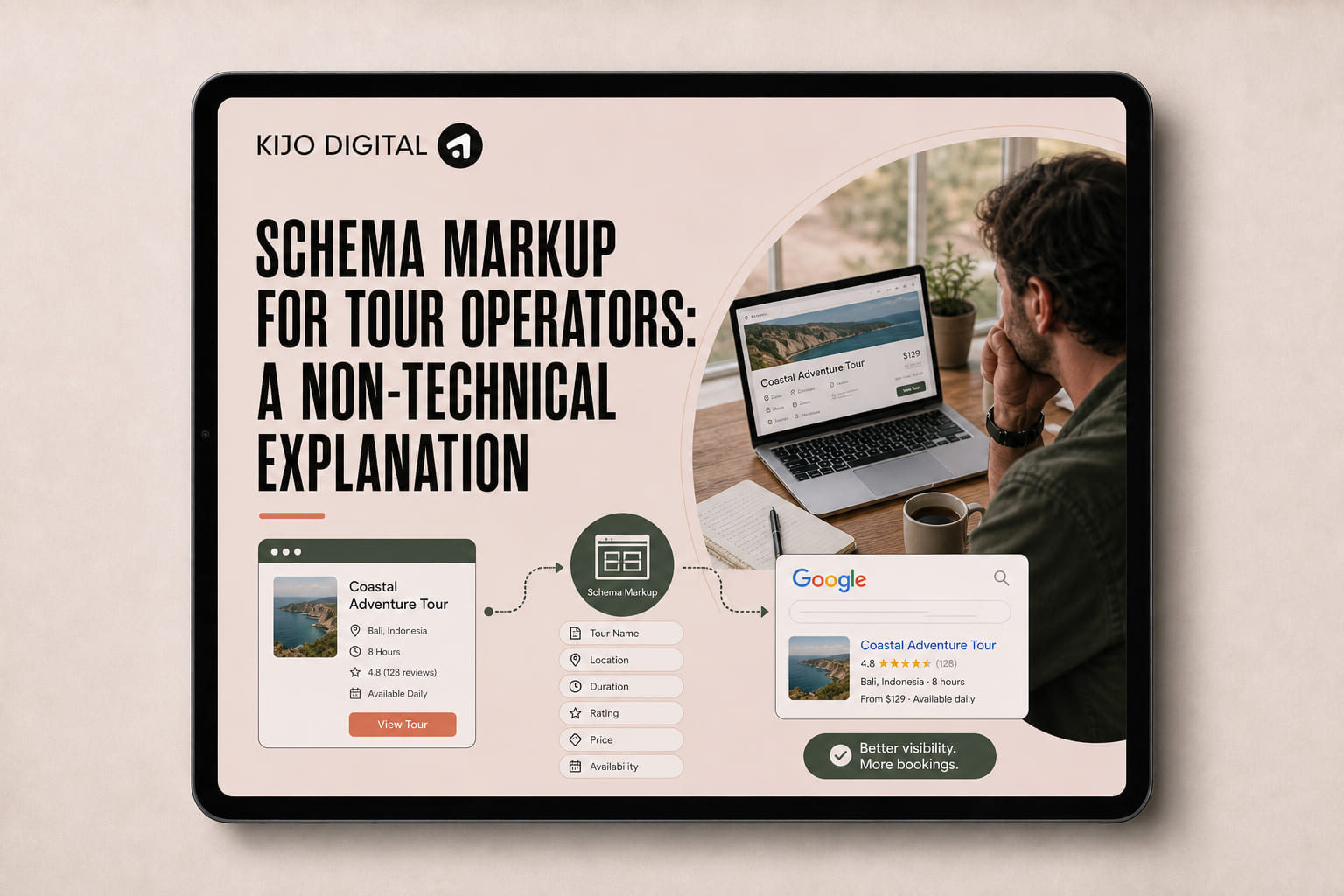
Imagine handing someone a page of your website printed out, no colours, no layout, just plain text. They could probably work out it’s a tour page, but they’d have to read carefully and infer things: this line is probably the price, this block is probably a review. Schema markup is the fix for that guesswork. It’s a small block of code added to a page that explicitly labels each piece of content: this is the price, this is a review, this is a frequently asked question, rather than leaving Google, or increasingly an AI tool, to infer it from formatting and context.
It’s invisible to a human visitor. Nobody browsing your site sees it or is affected by it directly. It exists purely to make your content unambiguous to machines reading the page.
Our guide on how to rank a tour operator website on Google touches on schema as one of the SEO foundations, but it deserves its own explanation because it solves a specific, common problem: a tour page that’s perfectly clear to a human reader can still be genuinely ambiguous to a search engine, especially when it comes to details like price, duration or availability that aren’t always phrased consistently.
Clear schema markup means Google is more likely to display richer, more accurate results for your tours, sometimes including star ratings, price ranges or FAQ dropdowns directly in the search results, which tends to improve click-through even before ranking position changes at all.
| Schema type | What it’s for | Why it matters for tour operators |
|---|---|---|
| TouristTrip / Product | Individual tour pages | Helps Google understand price, duration and what the tour includes |
| FAQ | Question and answer content | Can generate expandable FAQ dropdowns directly in search results |
| Review | Genuine displayed reviews | Can surface star ratings next to your listing in search results |
| LocalBusiness / TravelAgency | The business itself | Reinforces the entity behind the site for local and map pack results |
| BreadcrumbList | Site navigation structure | Displays a clean navigation path in search results instead of a raw URL |
As covered in the AI search section of our SEO guide, tools like ChatGPT, Gemini, Claude and Perplexity are increasingly involved in how travellers research trips. These tools rely heavily on being able to extract clear, structured facts from a page, and schema markup is one of the clearest signals available for exactly that. A page with well-structured tour and FAQ schema gives an AI tool something concrete and unambiguous to cite, rather than something it has to interpret from marketing copy. This is a core part of what our AI search optimisation work focuses on.
We’ll check your current schema markup against what Google and AI tools can actually detect, and show you what’s missing, free, no obligation.
You don’t need to look at any code to check this yourself. Google’s Rich Results Test tool lets you paste in any page URL and see exactly what structured data Google can currently detect on it, including any errors in how it’s implemented. It’s a genuinely useful five-minute check even for a non-technical owner, and a good first step before assuming schema is either present or missing.
Google reviews do two jobs at once for a small tour operator, and most owners only think about one of them. The first is trust: a traveller deciding between your website and a competitor’s is heavily swayed by review count and rating, especially for a purchase they’ve never made with you before. The second is search visibility: review volume, recency and rating all factor into how Google ranks your business locally.
The good news is that neither of these requires a large marketing budget. It requires a simple, repeatable habit of asking at the right moment, in the right way.
Marking up information that isn't actually visible on the page, such as fake or inflated review scores, breaches Google's guidelines and risks a manual penalty. Copying generic schema templates without adjusting the details for each specific tour often produces inaccurate or incomplete markup that undermines the trust it's meant to build. Schema should always describe what's genuinely on the page, nothing more.
If you’re not sure whether your site has meaningful schema markup, start with the Rich Results Test on your homepage and one or two tour pages. If nothing shows up, or what’s there is incomplete, this is one of the technical foundations we build into every tour operator website, alongside the rest of the work covered in our SEO services.
Schema markup is a small piece of code added to a webpage that explicitly labels what the content is, a tour, a review, a question and answer, rather than leaving Google to guess based on layout and wording alone.
Not on its own in most cases. Its main effect is making content easier and more reliable for Google and AI search tools to understand and display accurately, which supports rankings and visibility indirectly rather than acting as a direct ranking boost.
TouristTrip or Product markup for tour pages, FAQ markup on pages that answer common questions, Review markup where genuine reviews are displayed, and LocalBusiness or TravelAgency markup for the business itself, tend to matter most for tour operators specifically.
Google's Rich Results Test tool lets you paste in a page URL and see exactly what structured data, if any, Google can currently detect on that page, without needing to look at any code directly.
I design and build conversion-focused websites for travel, hospitality and trade businesses, and I've set up bookings on all of these systems, WooCommerce most of all. This comparison reflects what actually works on real operator sites, not vendor marketing.
Book a free 30-minute strategy call. We'll review your current schema markup and technical SEO together and show you what's missing.
Book a free strategy call →