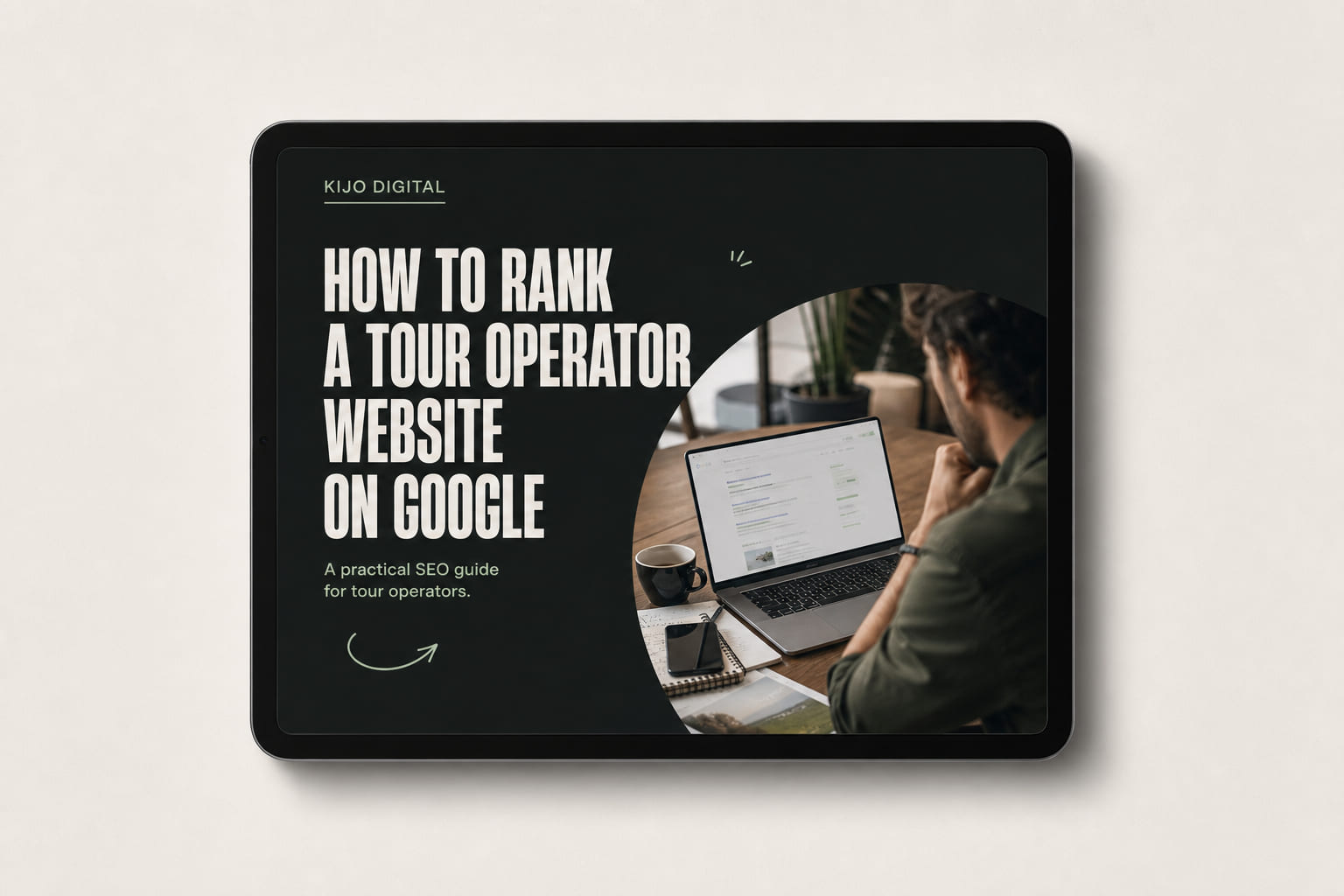
If Viator or GetYourGuide shows up above your own website when someone searches for your own tours, you’re not imagining it. Here’s why that happens, and the SEO and AI search foundations that actually change it.
It’s one of the more frustrating moments in running a tour business: you search your own tour name, and Viator’s listing for it sits above your own website. This isn’t a glitch, and it isn’t because Google doesn’t understand who you are. It’s because OTAs bring enormous accumulated authority to every listing they publish: thousands of backlinks, years of indexed content, and review volume that a single operator’s site can’t match on day one.
The realistic goal isn’t to out-rank Viator or GetYourGuide across the board immediately. It’s to win the searches an OTA’s generic listing genuinely can’t answer as well as you can: the specific detail about your tour, your exact departure point, your guide’s local knowledge, the practical question a traveller has before they book. That’s where a smaller, well-built site can outperform a much larger platform, often faster than operators expect.
The tour operator sites that struggle most are usually the ones where SEO was an afterthought: generic page structure, no destination content, and technical issues baked in from launch. Fixing that later is possible, but it's slower and more expensive than building it in from the start.
Before content and links matter, Google needs to be able to crawl, understand and trust your site technically. This is the unglamorous part that most operators skip, and it’s usually the reason a well-written page still doesn’t rank.
This is where most operators leave the most opportunity on the table. A single “Our Tours” page cannot rank for anything specific, because it isn’t specific about anything.
“A generic 'Our Tours' page can't outrank anything. Twelve specific, detailed tour pages have twelve separate chances to win a search.”
We'll review your current structure, content and technical setup and show you exactly what's holding your rankings back, free, no obligation.
If any part of your business has a physical presence or serves a specific region, a properly optimised Google Business Profile is one of the highest-leverage, lowest-cost things you can do. It affects whether you appear in the local map pack, and it’s often where a first-time visitor decides whether to click through to your site at all.
Schema markup is structured data added to your pages that explicitly tells Google (and increasingly, AI search tools) what your content actually is: a tour, a review, an FAQ, a breadcrumb. Without it, search engines have to infer meaning from your page’s design and wording, which is slower and less reliable than being told directly.
For a tour operator site, the highest-value schema types are typically tour or product markup, FAQ markup on pages that answer common questions, review markup where you have genuine reviews to display, and breadcrumb markup for clean navigation in search results. None of this is visible to a human visitor, but it’s one of the clearest signals you can give machines about what your page means.
Increasingly, travellers are asking ChatGPT, Gemini, Claude or Perplexity to help plan a trip rather than typing a search into Google. Being cited in those answers depends on a related but distinct discipline: generative engine optimisation, or GEO.
The good news is that most of the work that earns strong traditional SEO also earns strong GEO. Clear, well-structured, genuinely useful content serves both audiences at once.
| Type of search | Realistic timeframe | Why |
|---|---|---|
| Long-tail, specific questions | 1 to 3 months | Low competition, easier to answer better than an OTA |
| Your own tour and brand names | 2 to 4 months | Depends on your site's existing authority and technical health |
| Core commercial terms | 6 to 12 months+ | Competing directly against established OTAs and larger sites |
These are general ranges, not guarantees. The starting condition of your site, your destination’s competitiveness, and how consistently the work continues after launch all affect the real timeline.
If you’re starting from a weak technical foundation, fix that first: a fast, well-structured, mobile-friendly site is the base everything else builds on. From there, prioritise dedicated pages for your best-performing tours and destinations, add genuine FAQ content, and get your Google Business Profile in proper shape. Our tour operator website design service builds SEO and GEO in from the first page rather than adding it afterwards, which is consistently the faster and cheaper route to ranking well.
OTAs generally have far more domain authority, far more backlinks, and years of accumulated content and reviews across thousands of listings. A newer or smaller tour operator website is competing against that authority, not just against the OTA's individual listing page.
Meaningful movement for less competitive long-tail searches can happen within a few months of consistent work. Competing for your core commercial terms against established OTAs typically takes six months to a year or more, depending on how competitive your destination and niche are.
Not necessarily a blog specifically, but you do need content beyond your core tour pages: destination guides, practical travel information and answers to common questions. This is what builds the topical authority Google and AI search tools use to decide whether to trust and cite your site.
GEO, generative engine optimisation, is structuring your content so AI tools like ChatGPT, Gemini, Claude and Perplexity can understand and cite it. As more travellers plan trips by asking AI tools directly, being structured for GEO affects whether your business gets recommended in those answers, alongside traditional Google rankings.
Not for the broadest, highest-competition terms head on, at least not quickly. The realistic path is winning the long-tail, specific searches an OTA's generic listing can't answer as well: your exact tour, your exact destination detail, your exact traveller question, then building outward from there.
I design and build conversion-focused websites for travel, hospitality and trade businesses, and I've set up bookings on all of these systems, WooCommerce most of all. This comparison reflects what actually works on real operator sites, not vendor marketing.
Book a free 30-minute strategy call. We'll look at your site's technical health, content and structure, and show you the fastest realistic path to ranking better.
Book a free strategy call →