Answer-first content
A plain-language definition
The site answers “What is a self-guided walking or cycling holiday?” in plain, self-contained language that search engines and AI tools can easily understand.
Case study · Brand identity & website
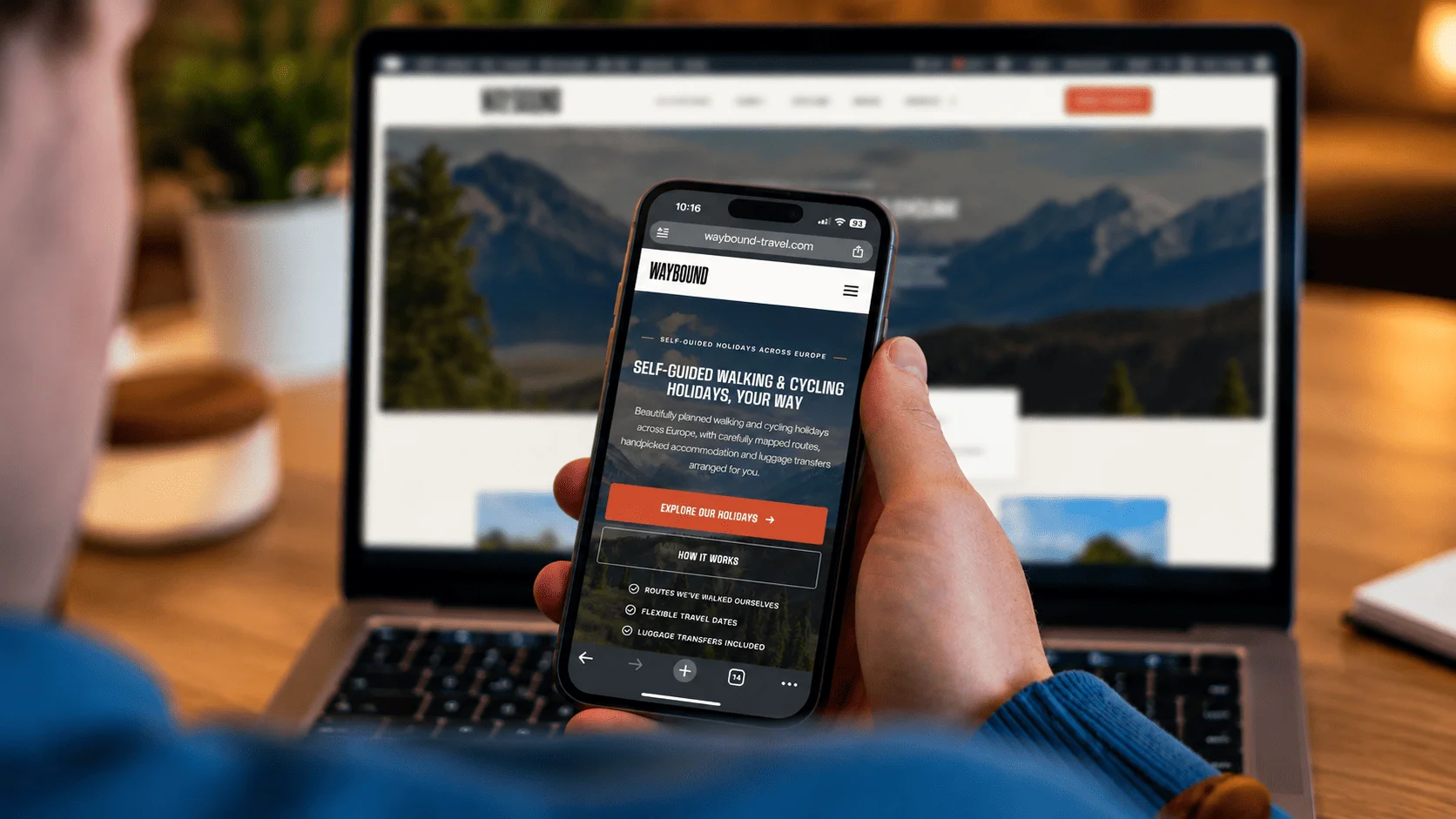
Waybound runs self-guided walking and cycling holidays across Europe: routes they have walked themselves, hand-picked stays and luggage moved ahead each morning. Kijo Digital created the logo and brand identity, designed the printed brochures, designed and built the website, and set it up to be found on Google and in AI search.
About Waybound. Self-guided since 2018, Waybound was founded by Niall Corcoran and Cecilie Bech Christensen, whose own self-guided trek around Mont Blanc shaped the idea for the company. Every route is personally researched, walked or ridden, and refined before it is sold.
The brief. Explain an unfamiliar way of travelling in seconds, make 48 routes across 11 countries easy to browse, earn trust for a trip bought months ahead, and turn inspiration into a flexible-date enquiry.
Part 2 · Website design
The website had two jobs: make the self-guided model obvious, and make a large catalogue feel small enough to choose from. Every design decision serves one of those two jobs.
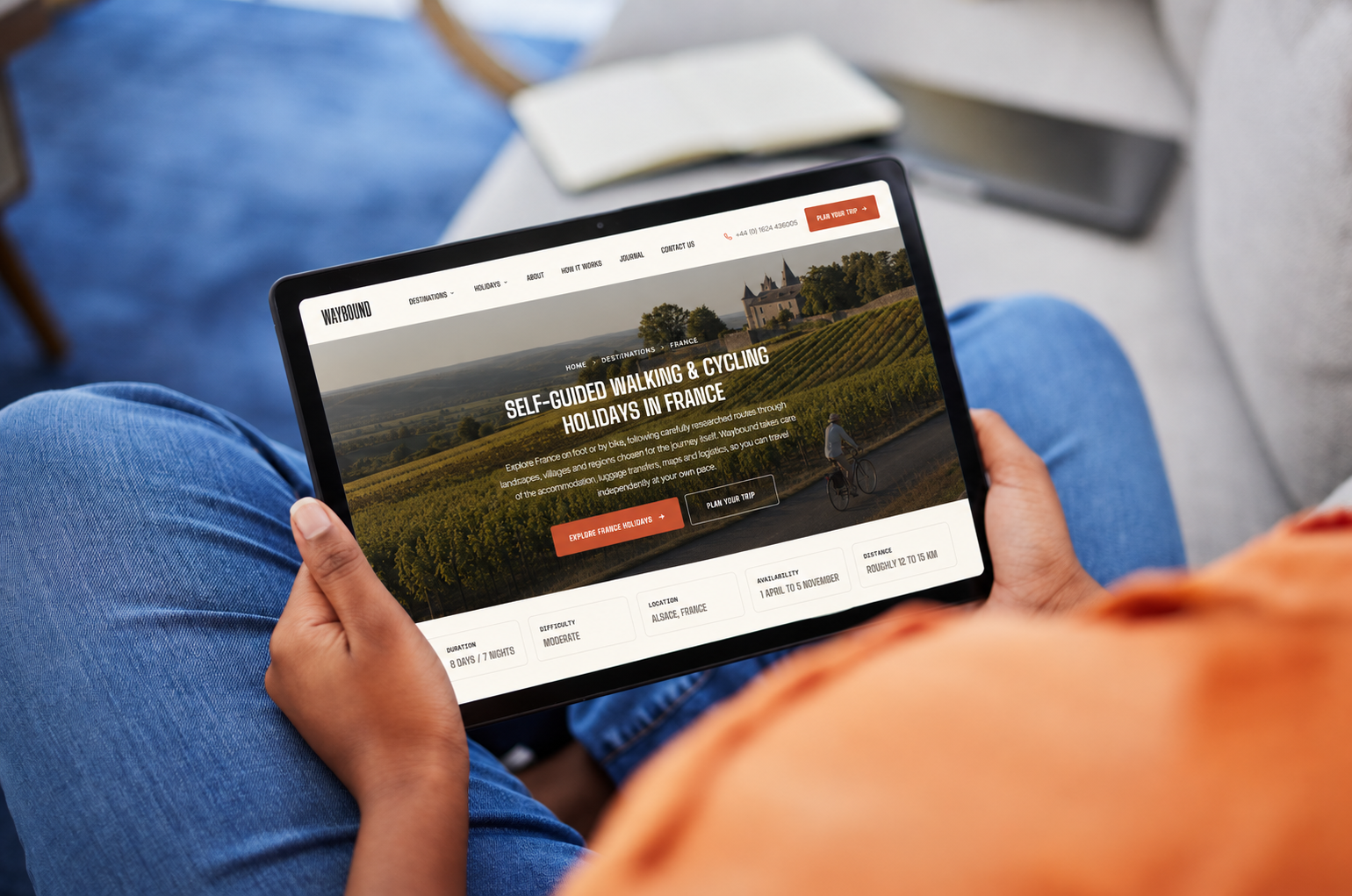
The homepage
Information architecture
Walkers and cyclists rarely start with a country. They start with how they want to move, so the menu leads with holiday types, then destinations, then the story and the “How it works” page.
Holiday type
Coastal paths, mountain passes and hill-town lanes, walked hotel to hotel.
Holiday type
Quiet backroads, river valleys and vineyard trails, at any pace.
Holiday type
Shorter days and gentler terrain, with stops chosen for children too.
Place
11 countries, from Ireland and Portugal to Greece and Switzerland, each with its own page.
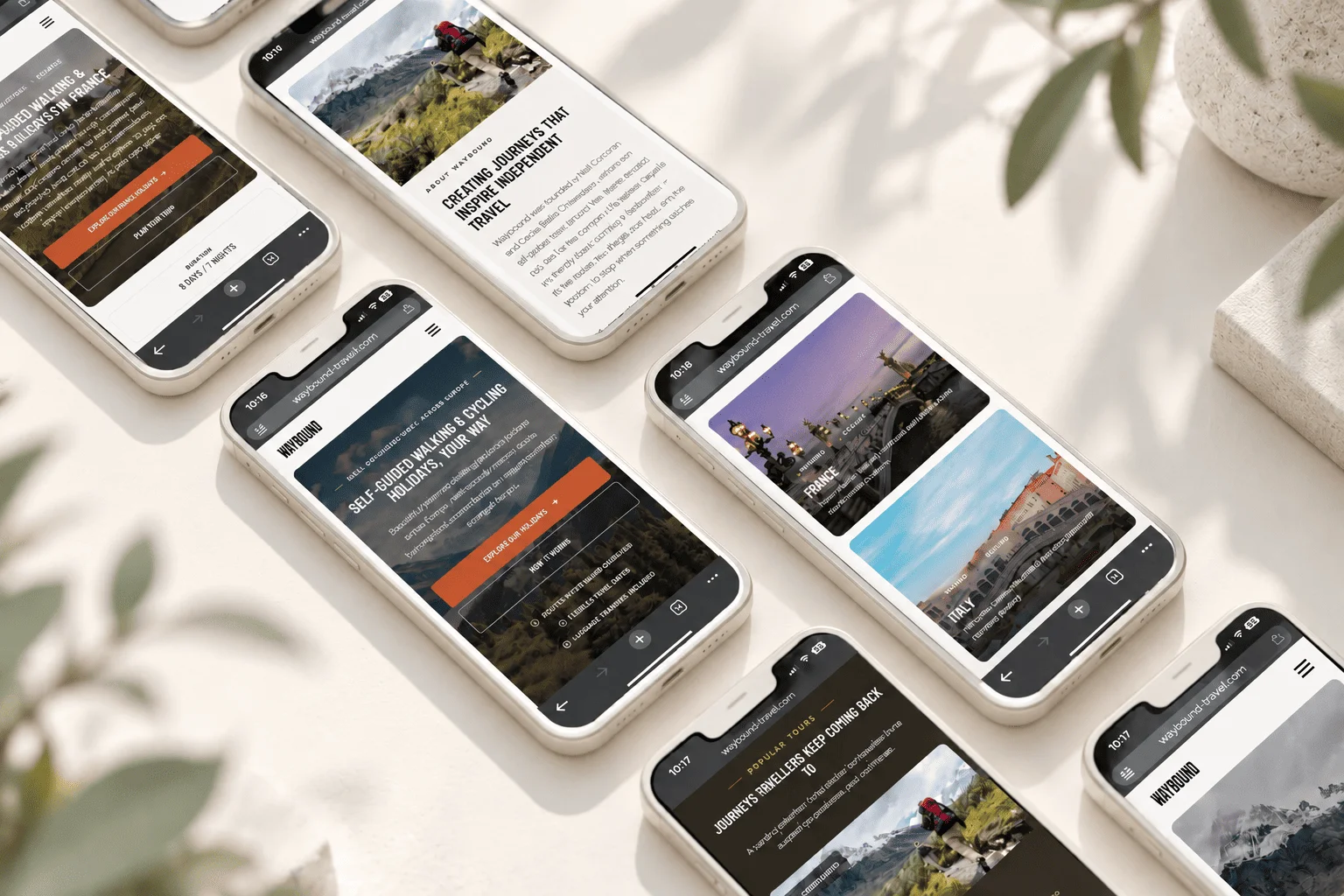
How it works
A dedicated page answers the first question every new traveller has, in three steps, then walks through the journey from booking to trail, what's included and what you arrange yourself:
Pick a route, a pace and your dates. There are no fixed group departures.
Accommodation, luggage transfers, route notes and maps, all arranged in advance.
Walk or cycle independently, with your bags moving ahead and a local contact on call.
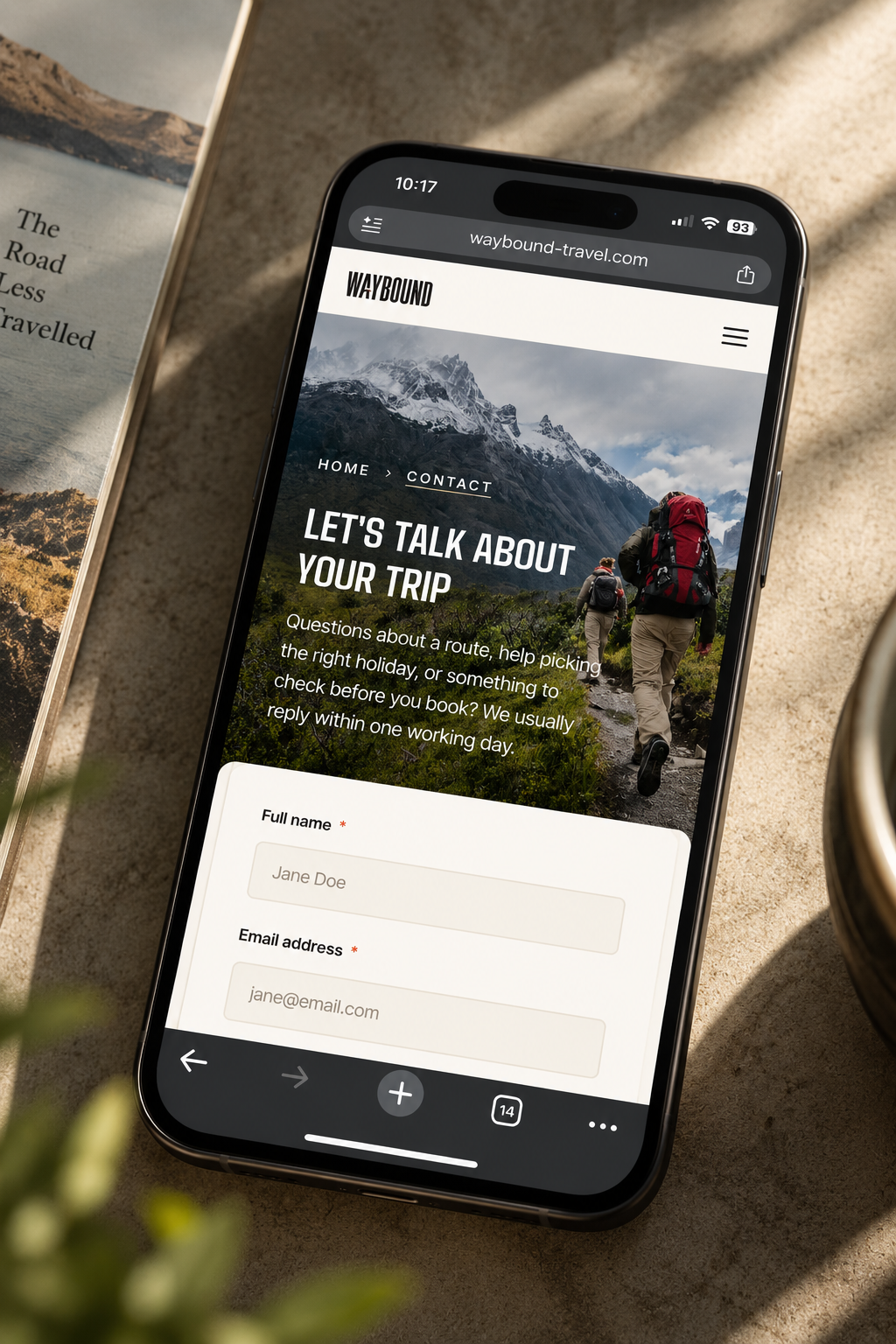
The enquiry
With no fixed departures to book, conversion is about momentum, not urgency. The journey keeps the next step visible without pushing:
A persistent call to action in the header and at every natural decision point.
A short enquiry framed around pace, place and dates, “no obligation, no pressure”.
Support throughout the trip, flexible start dates and free route amendments, stated next to the form.
Route cards
| Detail | What travellers see |
|---|---|
| Holiday type | Walking, cycling or family-friendly |
| Days | Trip length, for example 6 or 7 days |
| Difficulty | Easy, moderate or challenging |
| Route summary | One line on the landscape and the experience |
| Price | A clear from-price on every card |
Part 3 · Search & AI visibility
Almost no one searches for “Waybound” yet. They search for self-guided walking holidays in Italy or gentle cycling in the Loire, and increasingly ask AI assistants such as ChatGPT. The content is structured to meet that intent at every level.
Answer-first content
The site answers “What is a self-guided walking or cycling holiday?” in plain, self-contained language that search engines and AI tools can easily understand.
A topical hierarchy
Holiday-type hubs, a page for each of the 11 countries and individual routes form a clean structure for both broad and long-tail searches.
Questions answered
Pages answer what new travellers ask, such as “How does the luggage transfer work?”, “Do I need to be very fit?” and “Is Waybound suitable for families?”
Titles that match searches
Page titles mirror real searches, such as “How Self-Guided Holidays Work”, so each page has one clear job in search.
People and proof
The founders, the Mont Blanc story and “self-guided since 2018” give search engines and AI tools a real business behind the routes.
Specific facts
Days, difficulty, prices, inclusions and what you arrange separately are stated plainly: concrete detail that helps search engines and AI tools describe each trip accurately.
Want your travel business to be found the same way? See how we approach SEO for travel businesses and AI search visibility.
The outcome
What changed for Waybound, in plain terms. We add performance figures to a case study only once they have been measured and approved by the client.
Brand
Wordmark, palette, typography and printed brochures, created by Kijo Digital.
Catalogue
Every route card shows the same five details, so routes compare at a glance.
Structure
Every destination country has its own page, under clear holiday-type hubs.
Enquiry
Plan your trip from any page, with reassurance stated beside the form.
In the client's words
Working with Kijo Digital on the Waybound Travel website was the easiest decision we made this year. They understood self-guided travel straight away and turned it into a homepage that finally looks as considered as the trips we run. Warm, professional and genuinely a pleasure to work with.
Selling self-guided or tailor-made trips? Start a project →
Key takeaways
An unfamiliar way of travelling has to be understood before it can be wanted.
48 routes feel easy when every card shows the same five details.
A flexible-date enquiry with reassurance beside it suits a trip bought months ahead.
Related
Questions
Kijo Digital, a Cape Town agency that works only with travel and tourism businesses. We created the Waybound logo and brand identity, designed the printed brochures, designed and built the website, and set up its SEO and AI search foundations.
You travel independently along a route that has been researched, tested and mapped in advance, staying in accommodation booked for you, with your luggage transferred between stops. There is no guide and no group, just route notes, maps and a local contact if you need one.
Across 11 European countries: Ireland, Italy, Portugal, Spain, France, Greece, Austria, Germany, Denmark, England and Switzerland, with walking, cycling and family-friendly routes.
Let travellers choose how they want to travel first, then where. Give every destination its own page and show the same details on every route card, such as days, difficulty and from-price, so a large catalogue feels simple to compare.
Yes. We create brands and websites for tour operators, activity operators, DMCs and travel brands. Tell us about your trips through Start a project, or request a website audit first to see where your current website is losing enquiries.
Your trips, your website
Tell us about your trips and who books them. We will show you where your brand and website can win more direct enquiries.
More travel work

Luxury safari branding and a website built to turn wanderlust into enquiries across eleven destinations.
View case study →
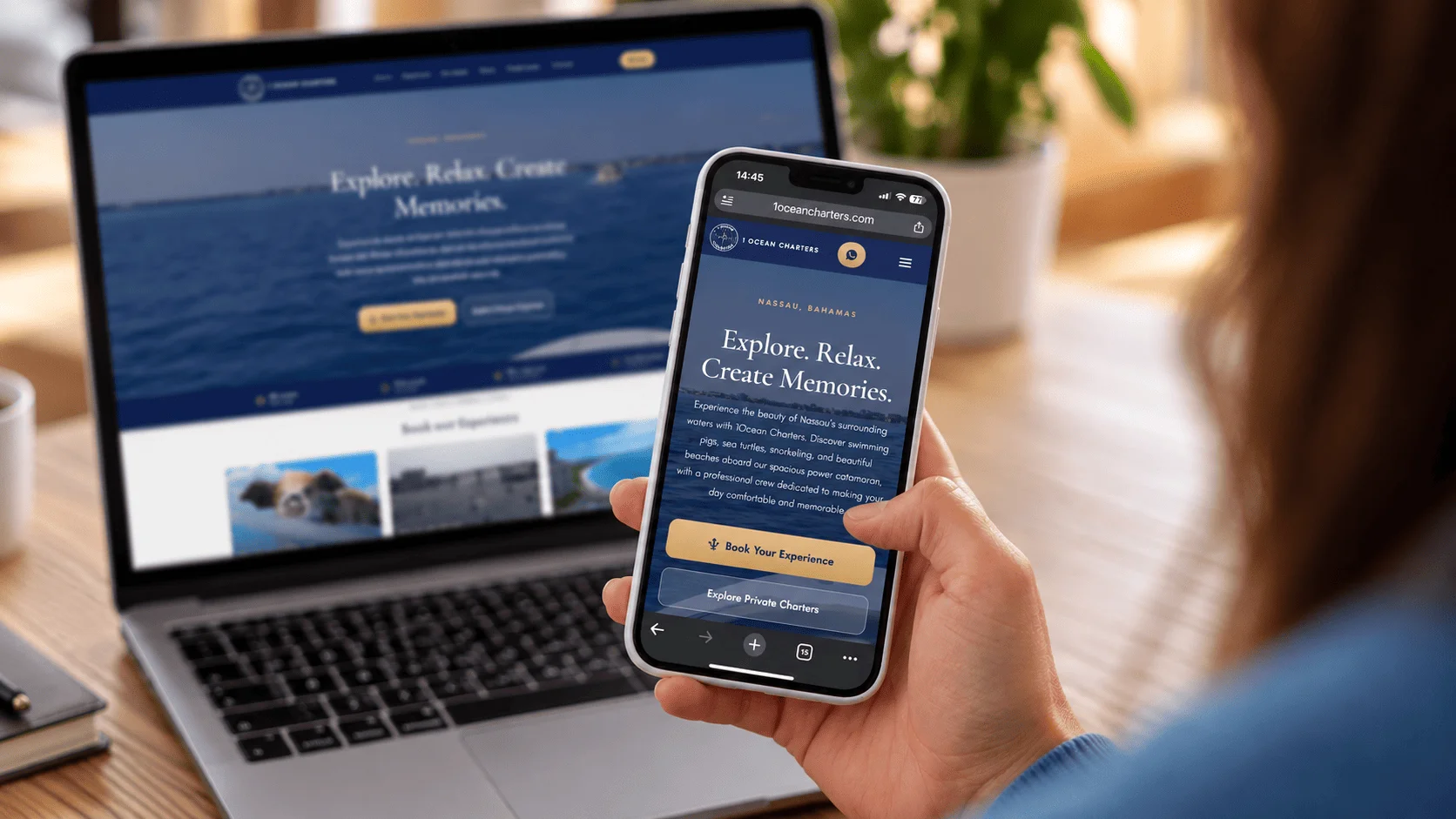
Boat charter branding and a direct-booking website for an owner-operated catamaran in Nassau.
View case study →