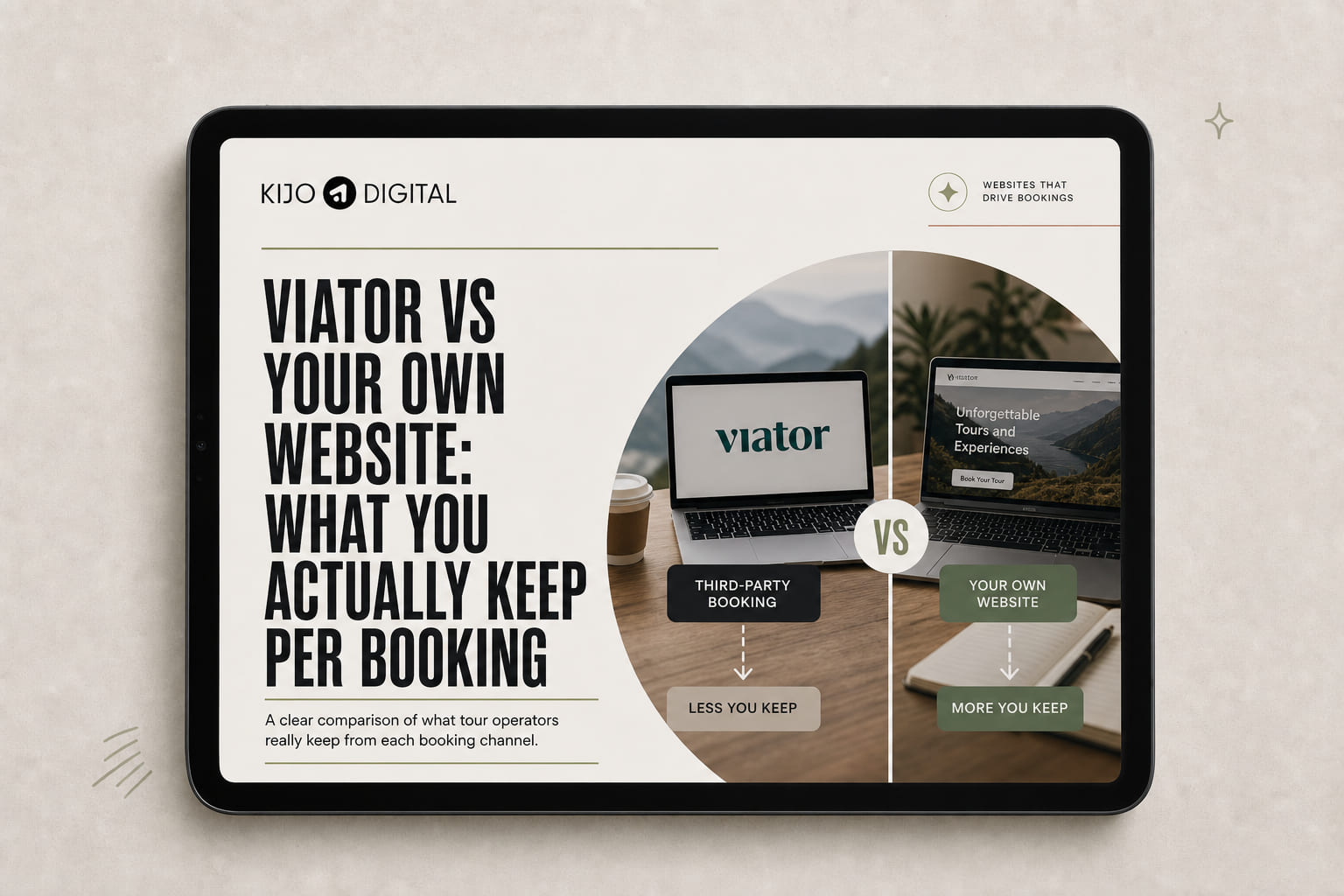
Same tour, same price, same traveller. Here’s what actually lands in your account depending on which channel they book through, worked out properly rather than estimated.
Take a tour priced at R2,000 per person, sold through both channels at the same list price. A Viator booking, at a typical 25 percent effective commission as covered in our Viator and GetYourGuide commission breakdown, nets the operator around R1,500. A direct booking through your own website, minus a typical 2 to 3 percent payment processing fee, nets closer to R1,940 to R1,960.
That’s a gap of roughly R450, or about 22 to 23 percent of the sale price, on an identical booking. It’s the single clearest number in this whole comparison, and it’s worth sitting with before getting into where the gap actually comes from.
Viator’s published base commission sits around 20 percent, but the effective rate most operators actually pay lands closer to 25 to 30 percent once optional placement programmes and per-product listing fees are factored in. This isn’t a one-line deduction on an invoice, it’s baked into the payout you receive, so it’s easy to underestimate unless you’ve gone looking for the exact number.
What you get in return is real: discovery, built-in trust from an established platform, and access to travellers who were never going to search for your business by name. The commission is the price of that access, not a hidden fee being extracted for nothing.
A direct booking isn’t free either, it’s just cheaper. The main cost is payment processing, typically 2 to 3 percent through a standard South African gateway, covered in more detail in our tour operator website cost breakdown. There’s also the underlying cost of the website itself and any ongoing marketing or SEO work that brings the traveller to your site in the first place, but those are largely fixed or amortised costs rather than a per-booking deduction, so they behave very differently to a percentage-based commission that scales with every sale forever.
The gap in isolation is one thing. What it means at real volume is another. Here’s the same R2,000 tour at three different annual booking volumes, comparing 100 percent Viator against 100 percent direct.
| Annual bookings | Net via Viator (25% commission) | Net via direct booking | Difference |
|---|---|---|---|
| 100 | R150,000 | R194,000 | R44,000 |
| 500 | R750,000 | R970,000 | R220,000 |
| 1,000 | R1,500,000 | R1,940,000 | R440,000 |
Almost no operator needs to choose all-or-nothing between the two channels, and our guide on whether you should delist from Viator covers why a full switch is usually the wrong move. But the table makes the underlying incentive clear: shifting even a modest share of that volume toward direct booking is worth real money, every single year, not just once.
We'll look at your real pricing, volume and current OTA mix and show you what shifting even 20 percent of bookings direct would be worth, free, no obligation.
The commission gap is the easiest number to point to, but it understates the real difference between the two channels in a few ways:
None of these show up in a simple percentage comparison, but they all push further in the same direction: toward the direct booking being worth meaningfully more than the raw commission number suggests.
The goal isn’t switching off Viator, it’s making your own website genuinely competitive for the booking once a traveller has found you, whether that’s through Viator, a Google search, or a referral. A site with visible pricing, a fast booking flow and clear trust signals, covered in our guide on trust signals above the fold, tends to move that ratio faster than trying to compete on price alone.
At a typical 25 percent effective Viator commission, a direct booking nets roughly 20 to 23 percentage points more of the sale price once payment processing is accounted for, since direct payment gateways generally charge 2 to 3 percent compared to Viator's 20 to 30 percent.
For most operators with steady booking volume, yes, and often faster than expected. Shifting even a modest share of bookings from Viator to direct can recover the cost of a proper website within a single season, and the saving repeats every season after that.
No. Viator bookings also mean losing the customer's contact details, which limits repeat bookings and referrals, while a direct booking gives you a relationship you can market to again. The percentage difference understates the real gap between the two channels.
On what you keep. Comparing list prices treats the two channels as equal, but they aren't, since a traveller paying the same price through Viator nets you significantly less than the same traveller paying you directly.
I design and build conversion-focused websites for travel, hospitality and trade businesses, and I've set up bookings on all of these systems, WooCommerce most of all. This comparison reflects what actually works on real operator sites, not vendor marketing.
Book a free 30-minute strategy call. We'll look at your actual pricing and OTA mix and show you exactly what shifting bookings direct would be worth to you.
Book a free strategy call →