
A real pricing breakdown, not a vague “it depends.” What actually drives the cost, the three tiers most operators choose between, and what to budget for beyond the build itself.
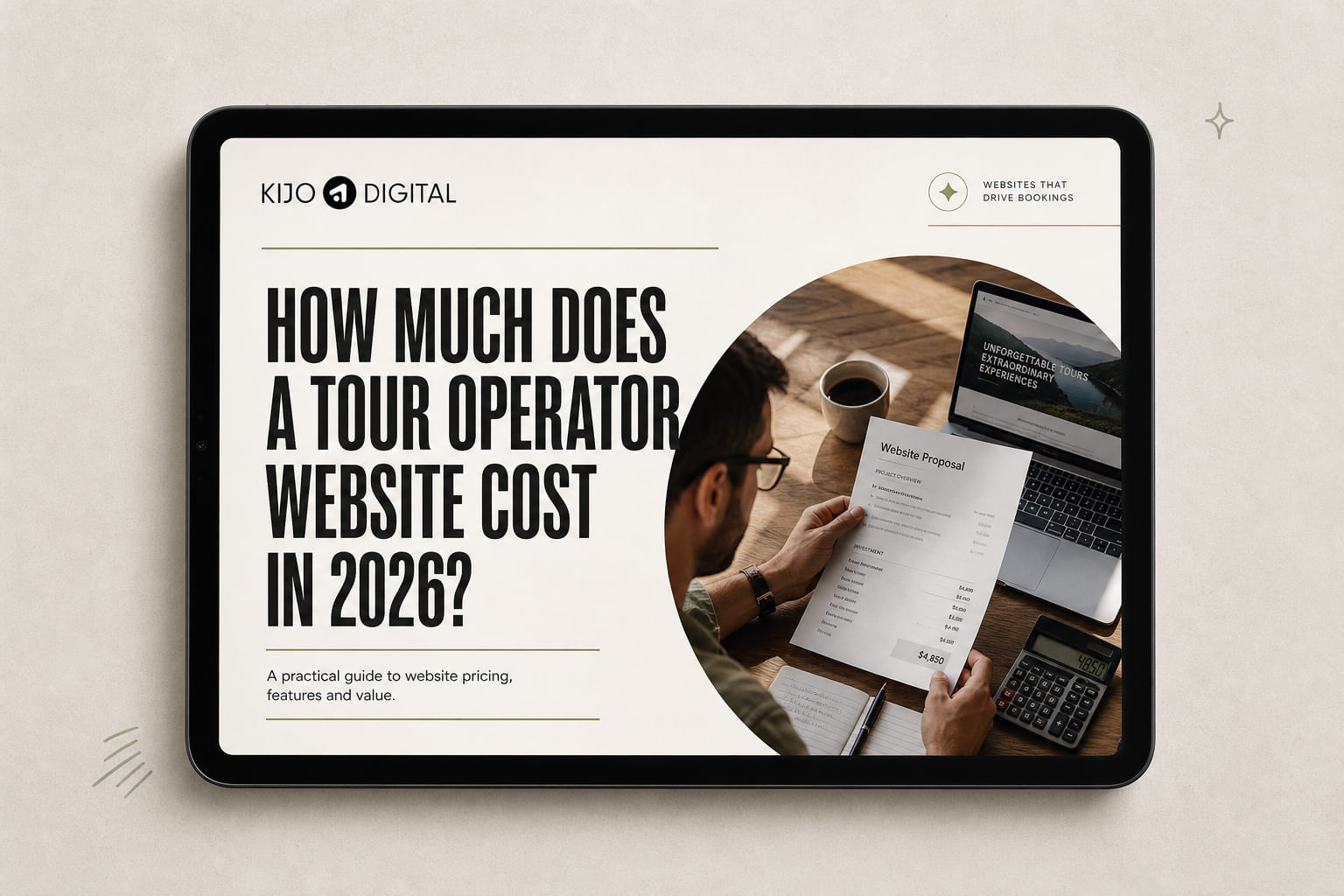
“How much does a website cost?” is a bit like asking how much a trip costs. A weekend at a backpacker lodge and a two-week private safari are both trips, and both have valid prices, but they’re not comparable. Tour operator websites work the same way: a single-page site with an enquiry form and a twelve-tour, multi-currency, booking-integrated platform are both “a tour operator website,” and quoting them the same number would be dishonest.
What follows is a real breakdown of what drives the cost up or down, three pricing tiers most operators actually choose between, and the costs that show up after the build that are easy to forget when comparing quotes.
Five things move the number more than anything else:
“Two operators asking for ‘a website’ can be asking for genuinely different projects. The scope, not the word ‘website’, is what sets the price.”
Most tour operators land in one of three brackets, whether they’re buying from an agency, a freelancer, or building it themselves.
A Wix, Squarespace or off-the-shelf WordPress theme site, usually self-managed or built with light freelance help. This is the cheapest route and can be a reasonable choice for a brand-new operator who needs a presence online fast while the business is still finding its feet. The trade-off is limited SEO control, generic structure that rarely follows the traveller’s actual booking journey, and a ceiling on how much it can be customised as the business grows.
A bespoke design built on WordPress, structured around your specific tours and booking journey, with proper technical SEO foundations, mobile optimisation and a booking engine or enquiry funnel wired in to fit how you actually sell. This is where most established small to mid-sized operators land, because it balances real customisation and performance against a realistic budget.
A larger build for operators with many tours, multiple markets, multilingual and multi-currency requirements, and deeper integrations across booking systems, CRM and marketing automation. This tier suits operators with meaningful volume and complexity, where the website is a core piece of business infrastructure rather than a brochure.
| Tier | Best for | Typical booking model | Main trade-off |
|---|---|---|---|
| Template / DIY | Brand-new or very small operators | Simple enquiry form | Limited SEO and customisation ceiling |
| Custom WordPress | Established small to mid-sized operators | Enquiry funnel or booking engine | Best balance of cost, control and performance |
| Full custom platform | Larger, multi-market operators | Full booking engine, multi-currency | Highest cost and longest build time |
We quote a fixed price after a short discovery call, based on your actual tours, integrations and goals, not a generic package.
The build price is the headline number, but it’s not the full cost of running the website. Budget for these separately:
The build cost only makes sense next to what it’s worth in return. If your OTA commission costs are running at 20 to 30 percent per booking, a website that shifts even a modest share of volume to direct bookings can pay for itself within a season, and keep paying for itself every season after that, unlike a one-off marketing spend.
An operator recovering even R150,000 a year in OTA commission by shifting a modest share of bookings direct can justify a serious website many times over, every year it keeps working. The cheapest quote is only cheap if it actually converts.
Price alone doesn’t tell you whether a quote is right for your business. These are more useful signals:
Before comparing quotes on price alone, get clear on your own scope: how many tours, what booking model, which integrations, and whether content and photography are ready. That clarity alone will make quotes far easier to compare honestly. From there, our tour operator website design service is built around exactly this kind of scoping conversation, with a fixed price after a short discovery call rather than a guess up front.
It depends heavily on scope, but most small to mid-sized tour operators pay somewhere between a template-based DIY build at the low end and a fully custom WordPress site with booking integration at the higher end. The number that matters is what a properly built site is worth to you in recovered OTA commission and better conversion, not just the build cost.
Sometimes, for a very new operator with no bookings yet who needs an online presence fast and cheap while they validate the business. Once you have real booking volume, the cost of a weak website in lost and leaked bookings usually exceeds the saving from choosing the cheapest option.
Hosting, a domain, an SSL certificate, booking system or payment gateway fees, and some form of ongoing maintenance and security monitoring. Most operators also budget for periodic content updates and, if they want the site to keep working harder over time, ongoing SEO or conversion optimisation.
No. Price reflects scope and craftsmanship, not automatically performance. A well-structured mid-range site built around the booking journey will usually outperform an expensive site that was designed for looks rather than conversion. Ask what a quote includes before comparing numbers.
If your current site has decent traffic and search rankings, a redesign that preserves that equity is usually faster and cheaper than starting over, and often produces results sooner. A full rebuild makes more sense when the existing site has structural problems that a redesign can't reasonably fix.
I design and build conversion-focused websites for travel, hospitality and trade businesses, and I've set up bookings on all of these systems, WooCommerce most of all. This comparison reflects what actually works on real operator sites, not vendor marketing.
Book a free 30-minute strategy call. We'll talk through your tours, booking model and goals, and give you a clear, honest picture of what it would cost to get right.
Book a free strategy call →