Most operators inherited this decision from whatever their website happened to launch with. It deserves an actual answer, and the right one isn’t the same for every tour.
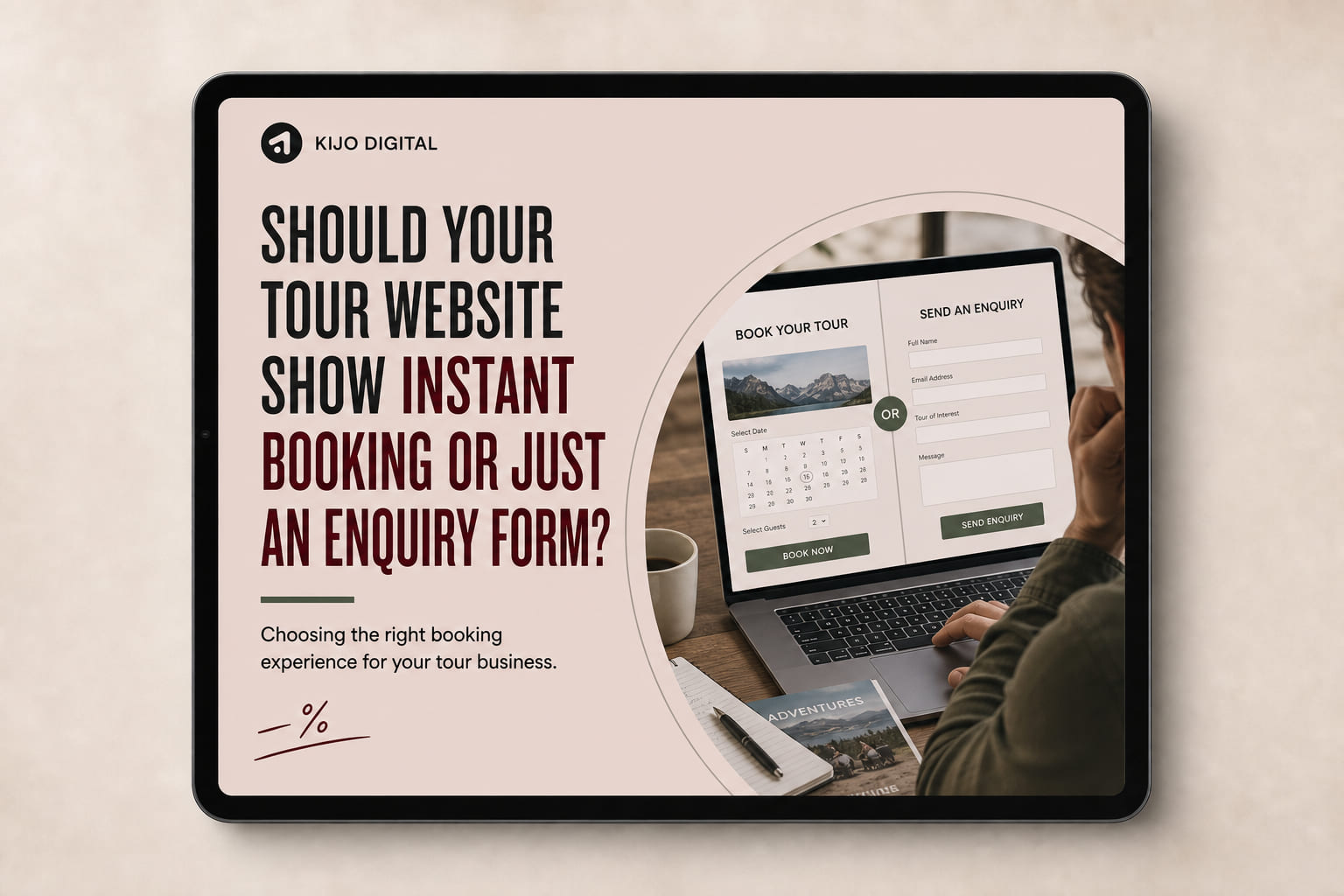
Ask most tour operators why their website uses an enquiry form instead of instant booking and the honest answer is usually “that’s what the site came with,” not a deliberate choice. It’s an easy decision to inherit rather than make, and it quietly shapes how many visitors actually convert, in either direction, depending on whether it fits how that specific tour is actually sold.
This sits next to the pricing question covered in why hiding your tour prices costs you bookings, since both are really about the same underlying issue: friction between a ready traveller and a confirmed booking.
Instant booking is the right default for tours with a knowable price, a fixed or predictable itinerary, and real-time availability that can be shown accurately. For a traveller who’s already decided, adding a wait for a reply is pure friction with no upside, and a share of genuinely interested visitors simply won’t follow through once there’s a delay they weren’t expecting.
It also compounds with the trust signals covered in our guide on trust signals above the fold: a visitor who trusts you and can see the price is exactly the traveller instant booking is built to convert immediately, rather than losing them to a competitor’s tab while they wait.
An enquiry form earns its place for genuinely bespoke experiences: tailor-made multi-day itineraries, private tours with variable group sizes, or anything where the final price and logistics depend on details the traveller hasn’t provided yet. Forcing instant booking onto something that can’t actually be priced or confirmed instantly just moves the friction somewhere worse, a booking that has to be manually adjusted or refunded after the fact.
The distinction that matters is between a tour that’s genuinely unknowable in advance and one that’s just been treated that way because it was easier to build a form than a booking flow.
Almost no tour operator needs to pick one model for the entire site. Standard, fixed-departure tours can use instant booking, while private tours, custom itineraries or large groups route to an enquiry form instead, covered in more detail in our guide on choosing a booking system. This is usually a far better fit than trying to force every tour through a single flow, and it’s the pattern we build into most tour operator websites from the start.
We'll look at your current booking flow and show you where instant booking or an enquiry form would actually convert better, free, no obligation.
| Tour type | Best fit | Why |
|---|---|---|
| Fixed departure, fixed price | Instant booking | No unknowns left to resolve before confirming |
| Small private tours, standard itinerary | Instant booking | Predictable enough to price and confirm automatically |
| Large groups, variable pricing | Enquiry form | Final price genuinely depends on group size |
| Fully bespoke, multi-day itineraries | Enquiry form | Cannot be accurately priced without a conversation |
Go tour by tour rather than deciding once for the whole site. Ask honestly whether the price and availability for that specific tour are genuinely knowable in advance. If they are, an enquiry form is adding friction for no reason. If they aren’t, forcing instant booking will just create admin headaches later. Our direct booking website checklist covers this decision alongside the rest of what a converting booking flow needs.
No. Instant booking generally converts better for fixed-departure, fixed-price tours with predictable availability, but an enquiry form is genuinely the right choice for bespoke, tailor-made or highly customised experiences where the details need to be discussed first.
For standard, fixed-itinerary tours, yes, generally. An enquiry form adds a delay and a step most travellers weren't expecting, and a share of genuinely interested visitors won't follow through once they have to wait for a reply.
Yes, and it's often the right answer. Standard tours can use instant booking while private, group or custom experiences route to an enquiry form, matching the booking model to what each specific tour actually needs rather than forcing one flow onto everything.
Defaulting to an enquiry form for every tour because it was the easiest thing to set up when the site was first built, rather than deliberately choosing the model that fits each tour's actual booking pattern.
I design and build conversion-focused websites for travel, hospitality and trade businesses, and I've set up bookings on all of these systems, WooCommerce most of all. This comparison reflects what actually works on real operator sites, not vendor marketing.
Book a free 30-minute strategy call. We'll look at your tours and current booking flow and show you where friction is costing you bookings.
Book a free strategy call →